GuideBeam is making career guidance accessible to everyone
Career decisions are getting harder just as students are expected to make them earlier. Better guidance now means wider exposure, clearer self-understanding and practical AI literacy.
Ask a Year 10 student what they want to do after school and you can usually hear the limits of the careers they have been allowed to see. The answers tend to cluster around the familiar: doctor, lawyer, teacher, engineer, business, a trade, maybe "something in technology" because that sounds sensible now. Those are not bad answers. They are often the only careers with any detail attached to them.
Most students have very little sense of what ordinary work actually feels like. They do not know what a policy adviser does on a Tuesday, what a cybersecurity analyst is looking for at 9:30 am, or whether the customer pressure and practical diagnosis inside a trade would energise or exhaust them. "Technology" could mean digital health, environmental data, product design, automation maintenance, AI governance or dozens of jobs that almost never show up in a standard school careers conversation.
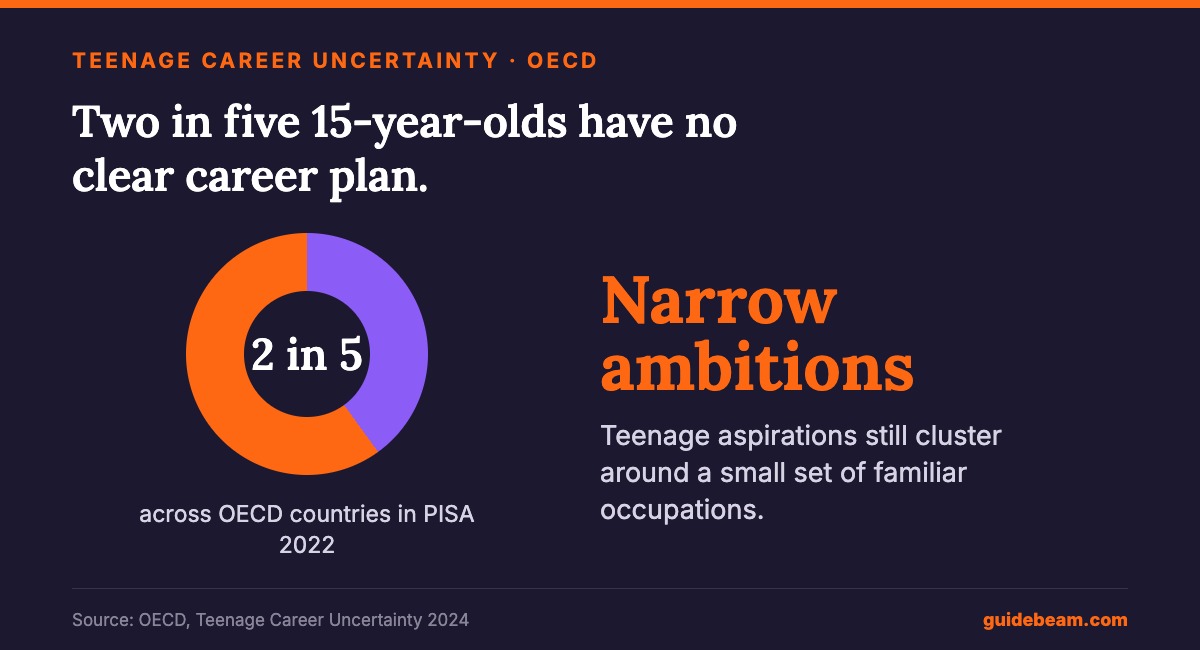
Yet this is the moment when they are asked to choose subjects, courses and pathways. The choices arrive early; the useful information often arrives late. In PISA 2022, the OECD found that two in five 15-year-olds across OECD countries had no clear career plans. The same research shows that teenage career uncertainty has grown sharply, while student ambitions remain concentrated in a narrow set of familiar occupations that often bear little relationship to labour-market demand. OECD, 2024
That is not a character flaw in teenagers. It is a visibility problem. They are being asked to choose from a map that is missing most of the streets.
The old career model is breaking down
For much of the last century, career guidance was built around a fairly stable idea of work. Choose a field, get the qualification, enter the profession, build experience, move up. The job might change around the edges, but the broad deal was clear enough. A student who trained to be an accountant, teacher, lawyer, designer, nurse or engineer could reasonably expect the work to look recognisable by the time they arrived.
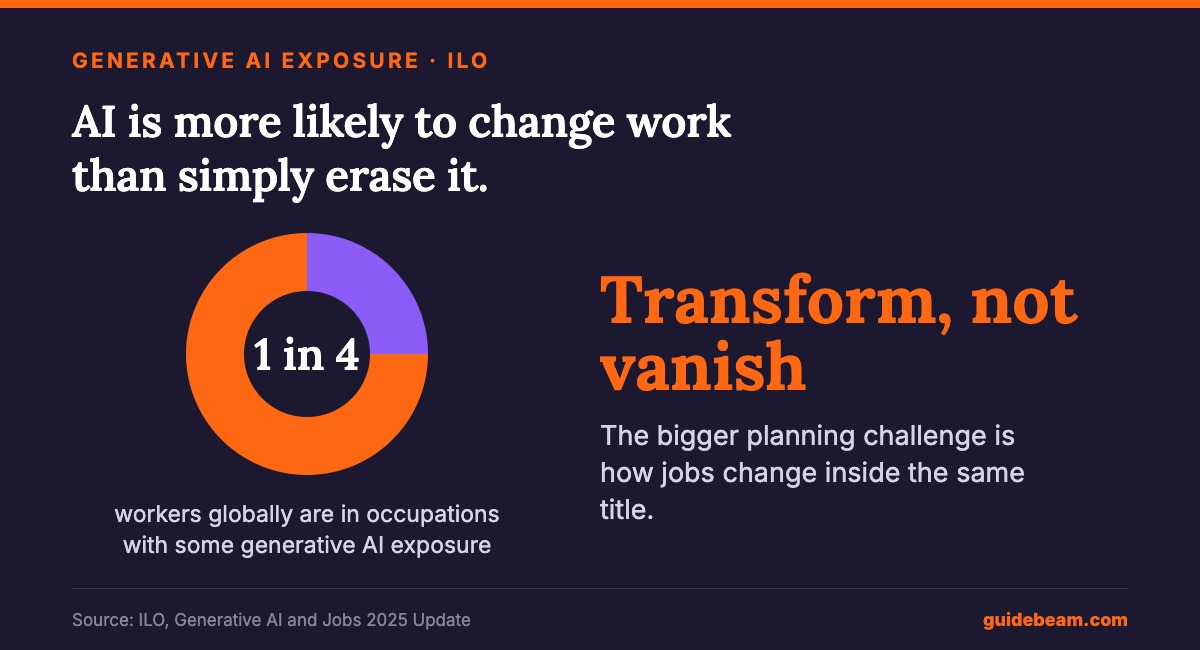
AI makes that assumption harder to hold. The International Labour Organization estimates that one in four workers globally is in an occupation with some exposure to generative AI. The more important point is not that one in four jobs is about to disappear. The ILO's stronger conclusion is that most affected jobs are more likely to be transformed than simply made redundant. ILO, 2025
That difference matters for a 15-year-old. A future accountant may still be an accountant, but the repetitive reporting, reconciliation and analysis that once filled the early years of the job may not look the same. A future lawyer may still be a lawyer, while research, drafting and discovery are reshaped around new tools. A future teacher may still be a teacher, but planning, feedback and personalised learning support may change around them. Marketers, health professionals, designers, tradespeople, administrators, researchers, customer-service workers and small-business owners all face their own versions of the same shift.
So the career question is no longer only, "What job do I want?" Students also need to ask: What parts of this work are changing? What will still need human judgement? What skills will make me useful as the role evolves? That is not a niche technology question. It belongs in every careers conversation.
"AI-proof" is a trap dressed up as a strategy
The understandable reaction is to look for safe ground. Students hear that they should avoid office work. Parents start looking for degrees that feel protected. Social media produces neat lists of jobs AI cannot replace. Trades are often offered as the clean answer because a robot cannot fix a burst pipe.
Some of that instinct is reasonable. Different kinds of work have different levels of exposure to automation. The World Economic Forum expects technological change, economic uncertainty, demographic shifts, geoeconomic fragmentation and the green transition to reshape jobs and skills through 2030. World Economic Forum, 2025
The problem is that "AI-proof" is still only one variable. It can become the same narrow logic students have always been given: choose what pays well, what sounds prestigious, what your family understands, or what appears stable from the outside. A career can be resilient to automation and still be a poor fit for the person entering it.
A plumbing apprenticeship, for example, can be an excellent path for someone who enjoys diagnosis, practical problem-solving, physical work, independence and dealing with customers under pressure. For someone who needs creative variety, quiet focus, clean environments or a different style of human interaction, the same path may be miserable. The job being safe does not automatically make it suitable. Fit and resilience have to be considered together.
Students choose from the careers they can see
The visibility gap is also an inequality gap. Some students grow up with career exposure built into their lives. They hear adults talk honestly about work. They know people in medicine, finance, construction, law, government, business, technology or design. They can ask questions at dinner, get a workplace visit, shadow someone for a day, or receive a realistic explanation of what a path actually involves.
Other students get a careers website, a university brochure and a question they are not ready to answer. The difference is not intelligence or ambition. It is access to the kinds of small, repeated encounters that make work feel real.
The OECD has repeatedly linked career-development experiences such as workplace visits, job shadowing, career conversations, job fairs and workplace-based learning with stronger employment outcomes later in life. Its 2025 review also shows that student aspirations remain narrow and unevenly shaped by social background. OECD, 2025
Career interest is not always discovered by looking inward. Often it appears after exposure. A student may think they dislike technology until they see cybersecurity investigation, digital health, game design or environmental data. A student who says they want medicine may eventually realise that what attracts them is helping people, solving difficult problems, working in a crisis or understanding biology. Those motivations could still lead to medicine, but they could also lead to nursing, paramedicine, occupational therapy, psychology, public health, biomedical research or pathways they may never have seen.
It is hard to become interested in a future you cannot picture yourself inside.
A one-time career test is not enough
Traditional career guidance often gives students a snapshot: here are your interests, here are five careers, good luck. That can be useful as a starting point, but it asks a lot of a teenager who may not yet know enough about work to answer the questions well. It also assumes the world of work will still look broadly the same by the time they arrive.
Students need more than a list of career matches. They need to understand the difference between liking the idea of a job and liking the lived reality of it. They need to know how they respond to pressure, routine, uncertainty, social interaction, physical work, detail, creativity, reward and independence. They need to see how their interests connect to real pathways, and which skills give them options if their first plan changes.
They also need ways to test assumptions before they spend years and money committing to them. A stronger career decision is usually made from evidence, not just a job title that sounded right at 15.
The best guidance is a living system
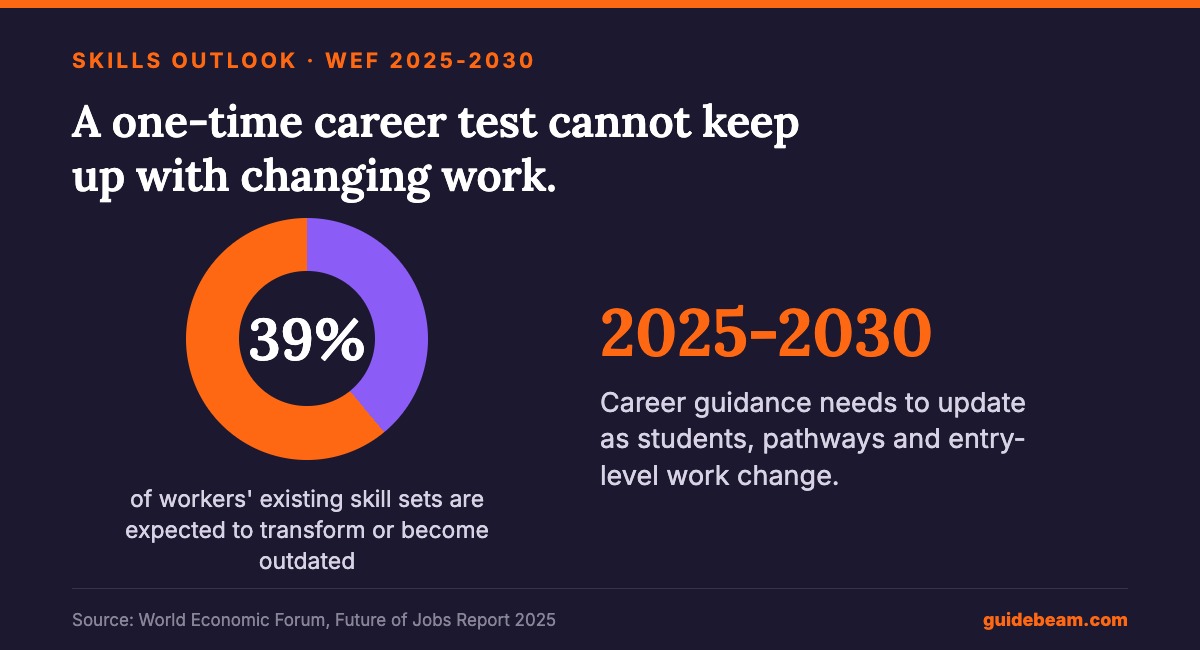
The World Economic Forum expects workers, on average, to see 39% of their existing skill sets transformed or outdated over the 2025 to 2030 period. World Economic Forum, 2025 That does not mean students should panic or chase every new trend. It does mean the old model of careers advice is too static.
A one-off assessment in Year 10 cannot account for the fact that a student will change. Their confidence will change. Their interests will become more specific. Their skills will grow. Their family circumstances may shift. New pathways will appear. Entry-level work will change. The labour market will move.
Career guidance should work more like navigation software than a one-page verdict. It should show where a student is now, what is changing around them, which next moves are strongest, and when the route needs updating. The point is not to predict a student's one perfect career at 15. It is to help them make better decisions at 15, 17, 20 and beyond.
What GuideBeam is building
GuideBeam is not here to tell a teenager exactly what they should become. Nobody can responsibly do that. We are building a career intelligence profile that evolves as a student does, and as the world of work changes around them.
It starts with self-understanding: interests, strengths, personality, values, motivation, work preferences, skills and real-life constraints. But self-understanding is only half the job. Students also need exposure to the work itself.
That is why GuideBeam includes a career simulator. It gives students a way to explore different worlds of work virtually, experience realistic scenarios, understand the decisions and pressures involved, and ask more useful questions: Would I enjoy this kind of problem? Could I grow into the day-to-day work? Is the pathway realistic for me? What should I test before I commit?
Because AI is changing the work inside almost every profession, GuideBeam's roadmap also includes AI learning opportunities for high school students. The aim is not to turn every student into a programmer. It is to help every student understand how to use AI safely, responsibly and intelligently in whatever path they choose.
UNESCO's AI Competency Framework for Students makes a similar case. It argues that students need a human-centred mindset, AI ethics, foundational understanding of AI techniques and the ability to participate responsibly in AI system design. UNESCO, 2024
The students who win will not be the ones who predicted the future perfectly
The students who do well will not be the ones who guessed the future perfectly at 15. They will be the ones who learned how to notice change, ask better questions, test assumptions and keep moving.
That is what connected families and well-resourced schools have long created informally: access to people, pathways, information and opportunities that make the world of work less mysterious. It should not be a privilege. Every student deserves more than a guess, and more than a one-time report built for a world that may no longer exist.
Your next step
You do not need to know your one perfect career at 15. You do need a better way to explore what fits, understand what is changing, and make your next decision with more than a guess.
GuideBeam helps students understand their strengths, motivations and work preferences; explore career clusters they may never have considered; experience realistic career scenarios through our simulator; and build practical AI capability for the work they may eventually do.