


PricingFor InstitutionsHelp Center
GuideBeam logoGuideBeam logo
PricingFor InstitutionsHelp Center
Sign In

We acknowledge the Ngunnawal people, the Traditional Custodians of the lands on which we work in Canberra. We honour their continuing culture and pay respect to Elders past and present. We recognise and celebrate the enduring contributions of Aboriginal and Torres Strait Islander peoples to learning, guidance, and community.

GuideBeam logoGuideBeam logo

GuideBeam helps you find your perfect career fit through AI psychometrics, future-skills mapping, and ethical, data-driven guidance.

© Copyright 2026 Guidebeam Pty Ltd. ABN 73 692 857 122. All rights reserved.

Thoughtfully crafted in Canberra, Australia.

About
  • For Institutions
  • For Clients
  • Blog
  • Contact
Legal
  • Terms of Service
  • Privacy Policy
  • Security & Privacy
Follow Us
  • LinkedIn
  • X
Jun 13, 2026

Half of Apprentices Quit. Here's How to Choose a VET Course You'll Actually Finish

Around 45% of apprentices and trainees never complete — and the number one reason isn't that the work was too hard. It's that the course wasn't what they thought it'd be. If you're about to enrol, the single most important decision you'll make happens before day one.

Cover Image for Half of Apprentices Quit. Here's How to Choose a VET Course You'll Actually Finish

Picture the apprentice who walks away in second year. The easy assumption is that the work beat them — too technical, too physical, too hard. The evidence points somewhere far more avoidable.

Of everyone who starts an apprenticeship or traineeship in Australia, only around 55% make it to the end. And when researchers follow up with the ones who left, the most common explanation has nothing to do with the work being too difficult — it's dissatisfaction with the pay, the conditions, the actual hour-by-hour reality of the job. They didn't fail the trade. The trade didn't fit them.
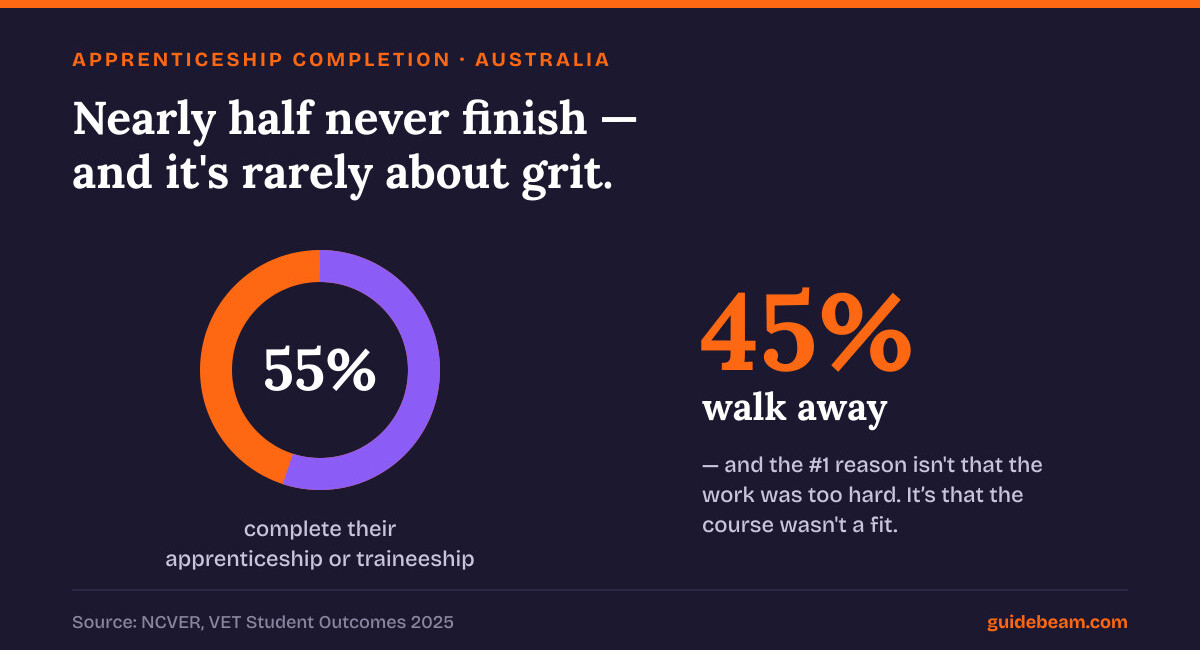
Nearly half of Australian apprentices never finish — only about 55% complete their apprenticeship or traineeship, and the number one reason apprentices give for leaving is dissatisfaction with the job, not that the work was too hard.

That distinction matters more than it sounds, because it moves the failure point. What went wrong wasn't the training — it was the choice made before any training began. Dropping out is mostly a fit failure, not a grit failure. And unlike grit, fit is something you can actually test in advance.

You didn't get the conversation you deserved

Here's how most VET decisions actually get made: you pick a course based on a job title you've heard of, a mate who's doing it, decent pay, or "it seems steady." Then you enrol. Then — months in, with debt accumulating and time spent — you discover what the work is genuinely like.

A submission to a NSW parliamentary inquiry put it bluntly: young people "make ill-informed decisions on VET courses without ever having spent a day in the industry or having had a real career conversation with someone in the field." Nobody sat down with you and asked whether you — your temperament, what energises you, what you can't stand — actually match the trade.

That's not a personal failing. It's a system gap. School career advice tends to stop at the ATAR conversation. The VET sector is brilliant at delivering training and weak at helping you choose the right training. So the cost of a bad match gets pushed onto you: the dropout, the debt, and worst of all the story you tell yourself afterwards — "I'm just not cut out for this."

You probably were cut out for something. Just not the thing you guessed at.

"AI-proof" is a trap dressed up as a strategy

Right now there's a stampede. Three in five Gen Z Australians say they're heading for blue-collar and trades work, and 80% of them give the same reason: AI can't do it. Trades pay is climbing — up around 30% in some areas — and "a robot can't fix your plumbing" feels like an unbeatable argument.

It's a real trend, and trades genuinely are more resilient to automation than a lot of desk work. But notice what's happening: a whole generation is making the that fills the dropout statistics — just with a trendier justification on top.
exact same blind decision

"AI-proof" tells you a job will still exist. It tells you nothing about whether you'll last in it. Choosing a career on a single variable — automation-resistance, or pay, or prestige — is precisely how people end up in the 45%. A plumbing apprenticeship is AI-proof and requires you to be on your feet in cramped, dirty spaces, problem-solving on the spot, dealing directly with stressed customers all day. If that drains you, the job being recession-proof and robot-proof won't keep you in it past year two.

AI-proof is not the same as you-proof. Both have to be true.

The pre-enrolment fit check

So how do you actually de-risk the choice before you sign up? You can't spend a day in every industry — but you can run three tests that surface the mismatches that cause most dropouts. Think of it as the conversation you should have been offered.

Test 1: The day-in-the-life test

Not the job title — the Tuesday. Find out what the work actually looks like hour by hour, then ask honestly whether that's a day you'd choose. An electrician's Tuesday is diagnosis, precision, and a lot of solo focus. A childcare educator's Tuesday is noise, unpredictability, and emotional labour from open to close. A diesel mechanic's Tuesday is heavy, greasy, physical, and quiet. Same "steady trade" label; completely different lived experience. Talk to someone two years in — not a recruiter, not a brochure — and ask them what the worst part of the week is. If you can live with the worst part, the rest takes care of itself.

Test 2: The reward-honesty test

Be honest about what actually keeps you showing up. For some people it's money, full stop — and that's a legitimate, stable motivator. For others it's autonomy, or seeing a finished thing at the end of the day, or helping a specific person, or status, or simply being left alone to do good work. People who choose a course purely on salary and discover they're wired to need autonomy or impact are the ones quietly miserable by month six. Money is the most expensive variable to choose on alone, because it's the easiest one to name and the worst predictor of whether you'll stay.

Test 3: The trait test

Your personality isn't a vibe — it's measurable, and it predicts fit better than your interests do. How you handle pressure, whether detail energises or exhausts you, how much social contact you need, your tolerance for routine versus variety: these traits quietly decide whether a trade feels like home or like wearing shoes a size too small. The uncomfortable truth from career research is that you're often a great match for work you assumed you'd hate, and a poor match for the thing you've been excited about. The only way to know is to actually look at your traits instead of guessing.

The money pressure that pushes you to choose wrong

One more force is working against you, and it's worth naming. 85% of young Australians experienced financial insecurity in the past year, and one in seven full-time students now also work full-time. When rent is due, "what pays soonest" beats "what fits best" every time.

That pressure is real and you shouldn't pretend it away. But here's the trap: choosing the fastest-paying course you can tolerate, dropping out at month eight, and starting over is far more expensive — in money and in time — than spending a week up front getting the choice right. The dropout isn't the cheap option. It just feels cheaper because the cost arrives later.

The part nobody tells you: finishing pays off enormously

It's easy to read all this as discouraging. It's the opposite. The same data that exposes the dropout problem reveals how good the payoff is when you finish the right course.

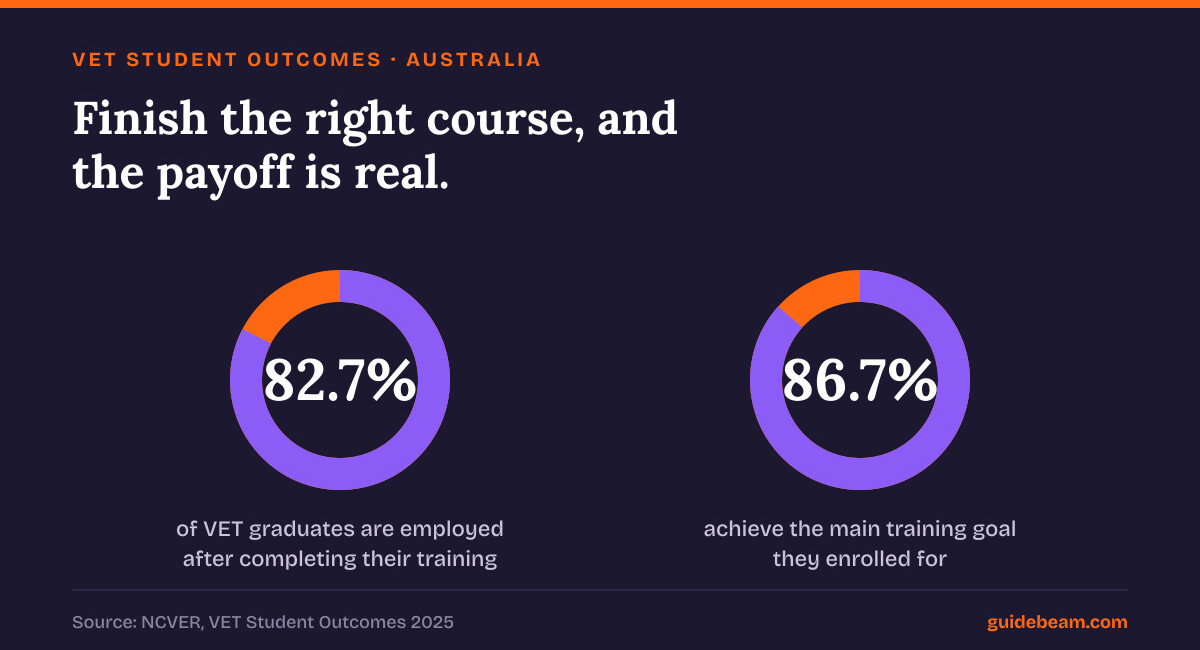
Among VET graduates, 82.7% are employed after training, and 86.7% achieve the main goal they enrolled for. Completion is the whole game — and completion is overwhelmingly a function of whether the course fit you in the first place. The students who run the fit check up front aren't just less likely to quit. They're the ones who walk into a job they actually want to keep.

Finish the right course and the payoff is real: 82.7% of Australian VET graduates are employed after completing their training, and 86.7% achieve the main training goal they enrolled for.

You don't have to be lucky. You have to choose with your eyes open.

Your next step

Before you enrol in anything, run the fit check on yourself — properly, not as a guess. GuideBeam measures your traits, your reward orientation, and your genuine strengths, then matches them against real career and course pathways — so you walk into your VET course already knowing it's the right one, not finding out the hard way eight months in.

The 45% didn't fail. Most of them just never got to choose well. You can.

Take the GuideBeam Assessment — and choose a course you'll actually finish.